Tuesday, June 26, 2012

Startups and a Common Misunderstanding in Agile Software Development

I've done four Free CTO Consulting Sessions in the past month with startup founders who all had run into variations of the same problem.  They didn't feel they had visibility into timelines and costs for development of their software.  They couldn't plan their business.  Investors and early customers were becoming worried about the ability of the founder to deliver.

In three of the cases, the founder was finding that the software teams (1 in-house, 2 outsourced) were delivering relatively well in the short-run.  The teams involved didn't seem to be exhibiting many of the Symptoms of a Weak Development Team.  The primary problem was that there always seemed to be a lot more that needed to be accomplished such that the big picture of what needed to get built was going very slow as compared to expectations.     As one founder put it:

We keep iterating over relatively the same features and functions.  We are finding and fixing bugs.  Making small changes.  But I'm now 4 months in on a release that was supposed to be done in 2 months.  And we are not even moving yet on the the next big release that I have to have to get my next round of funding.

In the fourth case, the founder was getting ready to sign a very large contract, but they didn't feel they had much visibility into what was going to be delivered.  Instead, what they had was a contract that promised Agile Software Development with Rapid Iterations and an incredibly vague list of features.  My belief is that you shouldn't sign that contract.  You are just setting yourself up for problems.  Actually, you are setting yourself up to be in the situation of the two founders that had outsourced.  They had both signed similar contracts and I'm not sure what's going to happen because clearly the outsourced developer is not delivering on the contract in terms of big picture features and functions.

In all four cases, I would claim that what's at fault is a common misunderstanding in Agile Software Development.  In particular, there's a tendency among many people executing an Agile process to focus on the short-term (Sprints, Iterations) and to forget planning and other big picture aspects.  There are many different Agile Software Development methodologies, but just about all of them have a strategic level element that focuses on the larger picture of the product.

Below are some pictures of Agile Development and you'll notice that each has a starting point of the big picture.

image

image

image

image

No matter what a developer implies or acts like, there is planning in their Agile methodology.

Of course, what's really at issue here is:

  • How much time/effort should be spent defining things that are farther away in terms of development?
  • How do we avoid continually iterating on a small set of product features/functions and lose progress on the bigger picture?

Level of Detail

So how deep do we need to go on features that are farther in the future?  Enough to have an estimate of the scope of the item.  I can hear the groans from all my fellow technical folks - we hate estimating things.  So why do I say this.  If you can't estimate it, then it's not defined well enough and you are just punting on getting it defined.  I'm not saying the estimate has to be exact, but a reasonable range is needed. 

I'm okay with splitting functions off into near-term and future.  A classic example might be "reporting" as a feature item.  What probably will happen is to define some early reports that will have more specific estimates.  Then as it gets into the distant future (12+ months out), it can be much fuzzier.

Why do I need this?  We are trying to establish the big picture over the next 6 months.  And we are using them to set expectations around what's going to happen in terms of the product.  If we don't force ourselves to the level of an estimate, we can't really do that and we'll have big time misunderstanding on what's going to get done.

For most early-stage startups the list of product features that are under consideration for a 6 month (or even a 12 month) period is not that big.   We are likely talking about an effort of 4 hours to 2 days.  In all four of the cases that sparked this post, the founder and the developer were willing to just put a single bullet item on a list (yes, "reporting" was a line item on one of them - ouch) that could have wildly different expectations and they clearly had not estimated these things.  In three of the cases, these were in contracts!  Of course, even for the internal development team, this is pretty much a contract with your founder.

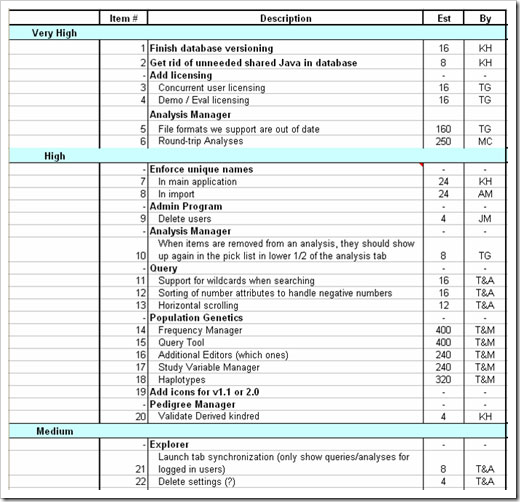
You don't need a lot of documentation of these items.  I personally like the Product Backlog type approach, but with more functional description than user stories (that can be more open to misunderstanding by developers).  For example you might be capturing these first in user stories and then into a feature level spreadsheet that link back to the user stories.
image

You can also look at:

http://www.mitchlacey.com/intro-to-agile/scrum/the-sprint-backlog

and there are tons of examples out there.  You will notice that all of them contain high-level estimates along with priorities.  This level of understanding only takes a few hours of time to get through.  Yes, it might be hard work, but you need to do this or you are setting yourself up for the kind of long-term misses that this post is about.

Unfortunately, there seems to be lots of confusion out there around this issue.  Part of this is confusion on terminology around various Agile methodologies and terminology.  But a big part of the problem is one of attitude.  A great post, Joe Little starts with acknowledging that Scrum and Agile proponents often downplay upfront planning.

... drowned out by Agilists saying "why do you want to do up-front planning?"

... all we 'scrumers' hate up-front planning

Joe points to reasons why proponents of Agile may try to avoid upfront planning including that things will change, so the initial dates/budgets are quickly wrong.  But Joe then goes on to point out why it's needed even with the negative attitude that Agile developers may bring:

  1. Help the business make decisions
  2. Team can see bigger picture and understand the tradeoffs
  3. Helps scope down early releases
  4. Team understands the whole project
  5. Leads towards Re-Planning

Also, take a look at:

The bottom line here is that neither the developer nor the founder/business owner should be willing to dodge upfront planning and getting to the estimate level.

Endless Iteration

The other problem that is being experienced is that each week the teams are setting the priorities to focus on bug fixes, small changes/new features around the same basic feature set and not getting to the next set of product backlog items. 

Okay, so part of this is a function of the quality of what is being built.  If there are a lot of bugs and each bug fix is causing new bugs, then it could be back to a Weak Development Team.  In these three cases, I would say that while I would have expected fewer bugs coming through the process with better development of test scripts, the overall symptoms were not horrible.  Most of the "bugs" were edge cases that were not really thought about until after the product was pulled together.  

The bigger part of this was that the business owners were defining additional features and functions that were needed now that they saw the system running.   In two cases many of these were coming from customers using early releases.  Some of these changes were important, but the critical question that I raised was:

What is the priority of these items vs. your product backlog items?

Many of the incremental changes and quite a few of the bug fixes were lower priority than moving on the product backlog. 

Why were they stuck in Endless Iteration?

  1. They had not accounted for the maintenance and support that comes with release.  If you start with an unrealistic picture of what's going to happen as you begin to release, you are going to create a big disconnect between your initial plan and what happens in practice.  As a developer, certainly as a CTO, you need to account for setting those expectations appropriately.
  2. They had not gone through a Re-Planning effort - mostly because they really didn't do any upfront planning.  If you look at Joe Little's last point about the value of upfront planning, it's setting you up for Re-Planning.  In these cases, not only did they have an unrealistic picture of what was going to happen once the software was released, but they continued with their pattern of not planning.  So instead of asking the priority of small changes vs. product backlog, they just sat in an endless iteration / maintenance mode.

I would also say that by starting into a process where you don't do big picture planning as you should, it shouldn't be a surprise when you are not making progress against the big picture.  You've established that the big picture is not as important as small increments and the team will align with that model.

Tuesday, May 22, 2012

Los Angeles Startup Events

I recently posted about the Increase in Early-Stage Startup Activity in Los Angeles.  In that post, I mentioned how one of the signals is the big increase in number of startup events and the number of attendees at those events.  I realized that it has been a little while since I posted about the Los Angeles Startup Community and so needed to update my list of startup events that will be out of date almost before I finish publishing it.

SoCal Startup Event Calendars

The following three sources are great at finding a lot of the startup events going on in Los Angeles and SoCal:
Even with all of those, they still often don't have all of the different meetings, especially smaller events listed.  So, you may also want to go look at:

Los Angeles Startup Events

Here are some of the events and meetups that I've spoken at, attended or at least interest me.  Of course, given the size of this list and having kids, I really can't attend a lot of these.  So, if you happen to read this and want to meet me, just reach out directly.

Monday, May 21, 2012

Startup CTO Speaking

Over the past several years, I've done lots of presentations around a wide variety of topics.  I was recently asked by an organization, "Tony, what topics can you cover?"  I realized that I've never captured topics that I've covered (I'm always willing to look at other topics), nor have I put up my speaker bio.  So, here goes:

Dr. Tony Karrer

Karrer-Tony-large-portraitOver the past 15 years, Tony has been a part-time CTO for more than 30 startups.  Most notably, he was the original CTO for eHarmony for its first four years making him partly responsible for more than 4% of the marriages every year.  He's also led  significant technology projects for a very impressive list of companies including Citibank, Lexus, Microsoft, Nissan, Universal, IBM, HP, Sun, and the list goes on. 
Tony has a Ph.D. in Computer Science and taught computer science for 11 years.  He is a frequent speaker at trade and industry events.

Select Startup CTO Speaking Topics

Making Sure You Are Ready to Begin Building Your MVP

So you think you're ready to start building your Minimum Viable Product (MVP)? Many non-technical founders miss documenting key features when communicating with their development team. In this presentation, Tony Karrer, a well known CTO for early-stage startups including eHarmony, will take you through the keys points you should consider before building your MVP such as: Features often overlooked when documenting an MVP for developers; Considerations when implementing social features; Understanding important metrics you want to measure; Risks and challenges in developing an MVP.

Building Your MVP as a Non-Technical Founder

Are you a founder who’s got a great concept and needs to get the product built? In this class, Tony Karrer, a well known CTO for early-stage startups including eHarmony, will take you through the keys to successfully getting your mobile/web product built.

Technical Advisors: Why Every Startup Needs Two, How to Find and Work with Them

After talking with several hundred startups over the past few years, there is a clear need for technical advisors to help specify the right things to build, make sure development is done right, plan past the initial MVP, review what is being built and generally cover gaps in the technical strategy and tactics.  Tony takes startups through the why and how of technical advisors.  Don't do a startup without them.

Ten Lessons from Working on 30+ Startups Over the Past 15 Years

Tony looks back over his experience working with startups and extracts elements that have led to success or failure.  Many of the factors are not obvious and include building mystery to drive margin, why boring B2B companies often win but are challenging in other ways, how bootstrapping wins, integrating metrics from the start and many other similar lessons.

Startup Feedback Panelist

Tony has participated on many panels where he can provide real-time feedback to startup founders.   Startups provide introductions and Tony and fellow panelists provide feedback in real-time.  These are exciting and fun experiences for everyone involved.

Evolving Role of Social Networks for Startups

In this talk, Tony traces the evolution of how startups have leveraged social networks and social media as part of their solutions over the past ten years.  Tony provides specific models and suggestions for how startups can leverage social networks for viral growth yet maintain their independence so as not to limit themselves long-term.

Matching for Startups

Having been involved in eHarmony from the start, Tony has naturally consulted with startups who are making matching a core aspect of their product including matching for social networks, careers, clothes, jobs, projects, college, tutoring services, doctors, service companies, investments, and many more.  As the web has led to exposure of every increasing numbers, people need ways to filter the possible options.   In this talk, Tony looks at where and how matching algorithms can be applied to give significant value to startups.

How Startups are Winning by Wiring into 3rd Party Services and Data

Probably the biggest change over the past 15 years in working with startups is the availability of 3rd party services that can be leveraged as part of a solution.  Its common for startups to think about services like hosting/computing, storage, analytics, maps, email delivery and tracking, and eCommerce.  However, there's really been an explosion of services over the past few years that gives even greater leverage and opportunity.  Possibly even more interesting is the rapidly growing data sources. In this talk, Tony first looks at the landscape of 3rd party services and data.  Then, he explores how several startups have leveraged those services and data in interesting ways.  He ends by looking at how this might help startups in the room.

Why Software Development Goes Bad So Often and What You Can Do About It

Most likely you've heard the staggering statistics on failure of software projects with different reports showing 28% success rates.  Tony is often called in after projects have reached a critical situation to try to help fix the problems such as blown budgets/schedules, poor quality code, never quite getting the last 10% done and other symptoms.  Unfortunately, for startups, the situation is often dire.  Development dollars have been spent and the system is not going to be able to be used for the business.
As a Startup, you have one shot.  What are you going to do to reduce your chance of problems and maximize your chances of real success?  What is the root cause of all of these problems?  How do you know if you may have issues?  What parts Agile addresses and the big problems with Agile for early-stage startups?
This presentation may make the difference between success and failure in your startup.

Metrics-Driven Startups

Virtually every startup has a model that has critical aspects to it that will make or break the business.  What is our lifetime customer value and how can we drive that up?  What does it cost to acquire a new customer?  What is our viral spread coefficient? 
The key for most early-stage startups is to understand the core metrics for your business, ensure you have visibility into those metrics, and then optimize the business around those metrics.  In this talk, Tony talks about the importance of these metrics for you and your possible investors, how startups typically gather these metrics without spending a fortune on reporting, and provides examples from eHarmony and other startups that may surprise you.

Stupid Things Founder Say - How to Work More Effectively with Techies

Software developers and other technical people are part of a very interesting club that has its own language, very specific rules, secret handshakes and, yes, they definitely talk behind your back and laugh at things that you say.  Unfortunately, once you've lost the respect of your technical team, it makes it hard to get work done and frankly becomes frustrating.  If you are not part of the club and don't speak the language, how can you work effectively with them?
Tony has been bridging that gap for 15 years with companies of all shapes and sizes.  In this talk, he helps you understand what you might be doing wrong today and how to change things to work with techies more effectively by understanding their motivation and getting yourself smart enough on critical items.

Monday, May 14, 2012

Startup Surge in Los Angeles

Ben Kuo just posted on SoCalTech:

Are the good times for startups back?

That seemed to be the mood running through the cloud at the more-than-sellout crowd at the Fairmont Miramar in Santa Monica Thursday at the first LA Demo Day. At the event, the enthusiasm for startups was palpable. The crowd of more than 1,500 spilled out into hallways, and would-be investors were turned away from the doors, as a crush of entrepreneurs, investors, service providers, wanna-be entrepreneurs, and others looked to be part of the surge of startups emerging in Los Angeles.

Certainly it feels like there's been a recent surge in Startup activity here in Los Angeles and as well nationally.  My two big data points are:

  1. What's happening in the Los Angeles Startup Events such as popular events like LA Demo Day.
  2. Increase in the number of inquiries I've been getting for: Free Startup CTO Consulting Sessions and/or other similar kinds of inquiries.

It has gone from 2 or 3 a week about a year ago to more than 5 per week. 

A lot of this action is early-stage startups and it's not clear to me how all of this will shake out given how hard it is for VCs to raise capital right now.

Are others seeing this as well?

Wednesday, April 18, 2012

CTO Salary and Equity Trends 2009-2011

Todd Gitlin of Safire Partners - a go to resource here in LA for recruiting C-level positions at startups - was nice enough to compile some data again this year (see last year's Startup CTO Salary and Equity Data and Equity for Early Employees in Early Stage ). Even better, my good friend and data visualization guru Steve Wexler of Data Revelations was able to create visualizations of the data.

Here's a live version of the data and below it is a bit of analysis of the trends.


I'm showing snapshots below. I would be very curious to get reactions to what people find in the live data.

CTO Salary and Equity Comparison

My guess is that most people who come here are going to be Founders, CEOs and CTOs who want to compare salary and equity of the CTO Position in their organization vs. their peers. Or they are looking at Hiring a CTO and want to see what salary and equity ranges look like.
Well the easiest visualization to use is to go to the Benchmarks Tab.
image
You then make selections around aspects like Founder Status, Job Title, Headcount, Revenue, Development Stage, Capital Raised, Funding Round, etc. If you get too specific, then the counts will get very small and may not be the best comparison. You can also enter salary and equity data to see where you stand.
As was pointed out in last year's post, generally there's as companies get older, have more funding, revenue, headcount, maturity:
  • Salaries go up
  • Equity percentage goes down

Trend #1 - Sizable Salary Increases

I've been talking for a while about the increasing demand for CTOs the past few years and a similar challenge in finding developers in Los Angeles. What I had not realized is that this had translated into escalating salaries for CTOs and VP Engineering. I was expecting that over the past few years, the pressure on VCs maybe had translated into lower salaries. It has not.


CTO-Salary-Trends-Overall-2011
I tried slicing this a few different ways, but in virtually every case the trend is clear. CTO salaries are escalating quickly.

Trend #2 - Early Stage Companies Lower Salary and Higher Equity (for Founder CTOs)

The one exception to Trend #1 seems to be for Startup CTOs at earlier stage companies. If you look at the year-over-year trends from 2009-2011 for companies that have raised less than $10M:


image
and another chart that is only startups with Seed or Series A according to development stage:
image


To me this is a very interesting set of trends that I would not have guessed without seeing the data.
Anyone else a little surprised? Or seeing something else that's interesting?

Monday, April 2, 2012

Hiring Developers Before Product/Market Fit?

Using my StartupRoar as a radar, I came across a great post by Gabriel Weinberg Do you really need a full-time hire for that?

Hiring seems to be the preferred use of seed funds (by investors and founders), whereas I'd prefer a focus on customer acquisition.

....

The problem is you don't yet have product/market fit, and until you do, you don't really know what to build. And that should be the focus of the founders -- to find the special fit that will make your company take off. When product vision is truly clear, then it makes sense to execute it, and hiring follows.

In the mean time, if you need some extra help, get some contractors to test out specific things. You may end up hiring these people eventually and you'll know more about them when you do.

I'm not sure I'd carry the argument quite as far as Gabriel does, but I completely agree with his central premise.  When I talk with early-stage companies, often the discussion starts with them asking me about Hiring a CTO for Your Startup, or  Finding a Technical Cofounder for Your Startup or How to Find Programmers for Your Startup.  In other words, they come in asking for help with sourcing and hiring.  These companies are very early-stage and definitely have not shown product/market fit.  Far from it.

In many cases, during my Free Startup CTO Consulting Session with them, we discuss where they are in in the process.  They are very early.  They need to determine product/market fit.  They need to conserve cash.

image

The startup founder is definitely not ready to hire a CTO.  And in most cases they are not ready to hire developers either.

Instead, what they should be considering is how to bridge the  Startup Founder Developer Gap and exactly what they need in terms of Startup CTO or Developer.

They most often really just need either a Part-Time CTO or Technology Advisor, and then some combination of hiring and/or outsourcing (on-shore or off-shore).  The Part-Time CTO or Technology Advisor will be able to help make that determination.

Of course, there's still hard work to be done to as the bad news is that its hard finding good Web Development in Los Angeles and certainly its tough  Finding Developers Here in Los Angeles. 

Great post Gabriel!

Monday, March 12, 2012

Finding a Technical Cofounder for Your Startup

I've recently received several emails from people looking for a technical cofounder for their startup.  I promised I would write this post with some thoughts and ideas on the topic.  Here's an example of that kind of email.

"I'm looking for a partner / cofounder who can not only head the technical aspects and build a working model of the site, but someone with the connections to put a great development team together when we need it. "

Typically, this requires quite a bit more information for me to be able to respond and provide real help.  I've talked about that in lots of other posts, so you can visit some of these to help determine what you specifically need:

Key ingredients in the equation are:

Okay, so now you have it narrowed down and have determined that you need:

  1. Part-Time CTO or Technology Advisor to help guide you and close a bit of the Startup Founder Developer Gap, and
  2. Equity-Only Cofounder Developer - the first real developer that will work for equity and produce the bulk of the application.

Of course, you will want to figure out a bit more about the specifics of what this developer needs to know vs. can learn.  Your technical advisor can likely help.

Before you go out looking for your Cofounder, you should also be thinking about what will motivate them as I talk about in How to Hunt Programmers for Your Startup - A Field Guide.

The bad news is that Finding Developers is Tough Here in Los Angeles and even people willing to pay have a hard time finding Web Development in Los Angeles.   Of course, you are looking for something a little different - a technical Cofounder.  The bad news is that they can get a good paying job anytime.  The good news is that likely is not what they want.

Where to Search for the Technical Cofounder

So where might you run into the right person?  Here are some ideas:

In your company or other companies.  Find the developers in your current company and other companies that you can get inside.  Get to know the developers.  Find out who is good.  Ask your friends to do the same.  Take lots of them out for free coffee, food, beer.  Ask them about your concept.

Tech Events / Meetups - In Los Angeles, There are lots of Networking Events in Los Angeles and Southern California that are techie oriented.   You should definitely hit up the Startup Weekend events as well.  And look at StartupDigest.com for lots of startup oriented events.

Make sure you meet the people who run these events.  They often can help a lot in navigating to expertise and to possible resources.

Student Groups - Go to the local university and find out what student groups there are for programmers.  Ask around for ideas on where they hang out.

LinkedIn - This remains one of my primary tools.  It's a bit hard to use to find a cofounder, but I would certainly go ask everyone I know to introduce me to programmers they know.  And then use them to get to even more.  

Twitter - You can run searches for various types of techie terms being used in a given geography.  Follow them and reply to introduce yourself.

Befriend Recruiters - Most recruiters will not be happy I say this as they generally don't like talking to people in this situation, but they still often will have lots of ideas for where technical people in your geography hang out. 

Sites - There are a bunch of sites out there aimed at this or similar issues.  Most of them suffer from lack of activity, but it's worth a shot.  Some sites to check out:

You can try finding folks via

Oh, and often there are forums for particular technologies where you can look.

Here are a few perspectives on the topic of finding technical cofounders:

In Building a sweat equity team, Joel on Software tells us:

You simply need to network. Go to user groups. Go to tech (or other relevant industry) events. Refine your elevator pitch. Eventually you'll catch the ear, the vision, of someone who would like to jump on board, and has something you need in return.

A great post by Elizabeth Knopf , FounderDating: How I Found My Co-Founder where she breaks down the process much like how you think about a sales process.  I'm focusing on the sourcing ("lead gen" on her slide) aspect.

image

In Please, please, please stop asking how to find a technical co-founder, Jason Freedman tackles this a different way and suggests how you "earn a technical cofounder" along the lines of:

  • Learn to Code
  • Build the Front-End
  • Test on Paper
  • Build a Following
  • Spend Some Money

Here are a bunch of other articles on the topic of Cofounders.

  • How Much Equity a Technical Cofounder Should Get
  • 6 Ways to Find A Technical Co-Founder
  • Places to Find Developers in Exchange for Sweat Equity
  • How To Find A Programmer To Build Your Startup Idea
  • Bootstrapping a Lean Startup
  • Finding a Technical Partner for Your Startup
  • Finding Your Co-Founders
  • CTO Equity - Negotiation After Funding
  • Startup CTO Salary and Equity Data
  • Hiring a CTO for Your Startup
  • How to Hunt Programmers for Your Startup - A Field Guide
  • How I Found a Great CTO
  • We have a CTO, and so can you!
  • Why Your Startup Can’t Afford To Hire a CTO
  • Advice for CTO Founders: Don't Let Business Kill the Business
  • The Different CTO Roles
  • Why Your Startup Can’t Afford To NOT Hire a CTO
  • HOW TO: Hire the Perfect CTO
  • Finding a technical co-founder: You’re doing it wrong
  • How to find a technical Cofounder
  • Technical Cofounders are Overrated
  • A Minimum Viable Team is more important than a Minimum Viable Product
  • 7 Startup Co-Founders That Can Lead to Conflict
  • What is the best way to divide up ownership in a startup?
  • Ten Steps in Choosing the Right Startup Partner
  • Lockboxer CEO: You Don’t Need A Technical Co-Founder To Start A Web Business
  • How to pick a co-founder
  • The Co-Founder Mythology
  • Finding Your Co-Founders
  • Spencer Fry — Picking Your Co-Founders
  • Do I Need a Co-Founder: The 90/50 Rule of Startup Founders
  • How To Work Better with Your Co-Founder
  • How Do I Know You Are Mr. Right (Co-Founder)?
  • Why you can('t) recruit a technical cofounder
  • AskBob: Where do I find developer cofounder?
  • Things to Avoid When Recruiting Co-founders
  • Finding Technical Cofounders Is Hard
  • Need a Technical Co-founder? Hire a Product Design Lead First
  • Nailing that elusive technical co-founder
  •